Or – how I used user research, data analysis, and collaborative design to envision (and align a team on) the future of a core product offering.
The challenge
Handshake is primarily known as a jobs board, but its jobs experience was slowly falling behind the competition.
The job search experience lacked much of the polish and completeness expected of a consumer-grade product; basic features like type-ahead & saved searches were missing, filtering was a hodge-podge from years of additions, and the relevance of search results was ‘mid’ at best.
There was no coherent, long-term roadmap of improvements to prioritize work against.
The work
As design lead, I spent 2 months exploring new futures for Handshake's job search experience, ultimately using the work to align our product team and leadership on multiple quarters worth of new projects.
Below are a few of the feature proposals that resulted from the work.
Job alerts: get the jump on new job postings
Competitive analysis and interviews with students quickly revealed that our lack of a saved search / job alert experience made it more difficult to find fresh jobs.
Job alerts give students a one-tap solution to staying on top of new jobs that meet their specific search criteria; they can combine keyword searches and filters, and be configured to send daily or weekly via email and push notification.
The feature launched in December 2023, and in the first month produced a 26% increase in the number of jobs saved by students, and a 5% increase in completed job applications.
Core search and type-ahead
Surprisingly, our job search experience lacked any semblance of type-ahead features, likely contributing to the very low conversion rate to job saves and applies from keyword searches. A lack of help from Handshake left students with no idea how rich our inventory of jobs was, since they had to guess as to what they might be able to search for.
One of my proposals was to introduce type-ahead, which has now been launched – and increased job saves after keyword searches by 122%.
Upgraded filtering experience
It was clear from research that our filters weren't cutting it: students were overwhelmed by the choices and couldn't find basic filters like pay (because they didn't exist!)
Updating our filtering experience was table stakes for an improved job search. I referenced usage data to cut down the ones we didn't need, and interview & survey insights to propose new additions.
The team has used the concepts to iteratively improve filtering; pay, company size, and collections filters have been added, and a number of others removed. Pay has been the most popular filter, leading to a 56% in applied filters and a 9% increase in jobs saved by students.
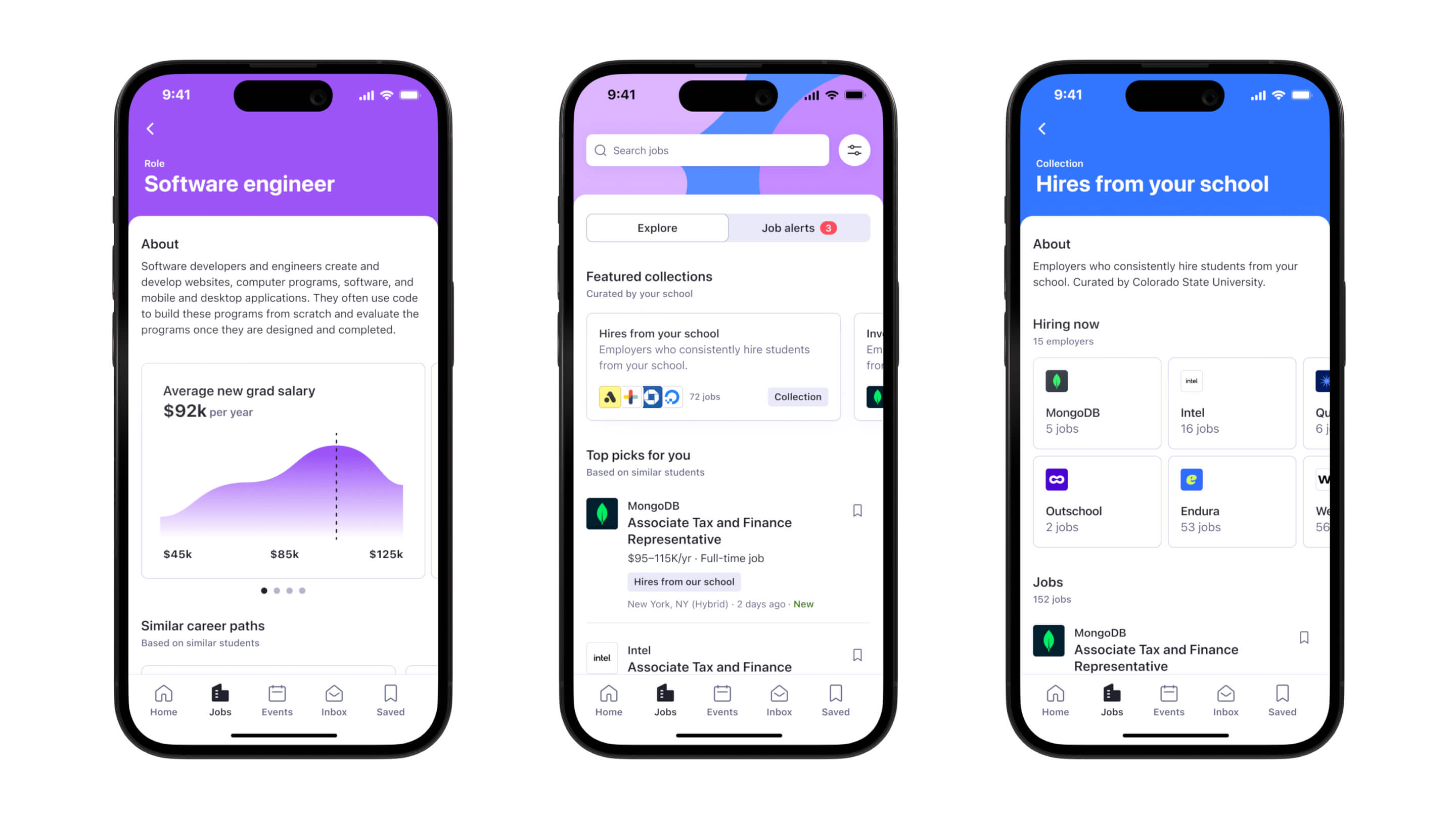
From L to R: career path explorer, discovery landing page, collections.
Jobs and career discovery: a suite of exploration-focused features
Key insights from user research and usage data told us that students just weren't interacting with keyword searches or filters – they preferred to scroll and see what the algorithm found for them because the student population is particularly unsure of what jobs they should be looking for.
With this in mind, I proposed a suite of discovery-related features to give students a more curated, personalized 'feed-like' experience within job search.
Of the features, school-picked collections has launched, leading to a 18% increase in job saves and 155% increase in job impressions.
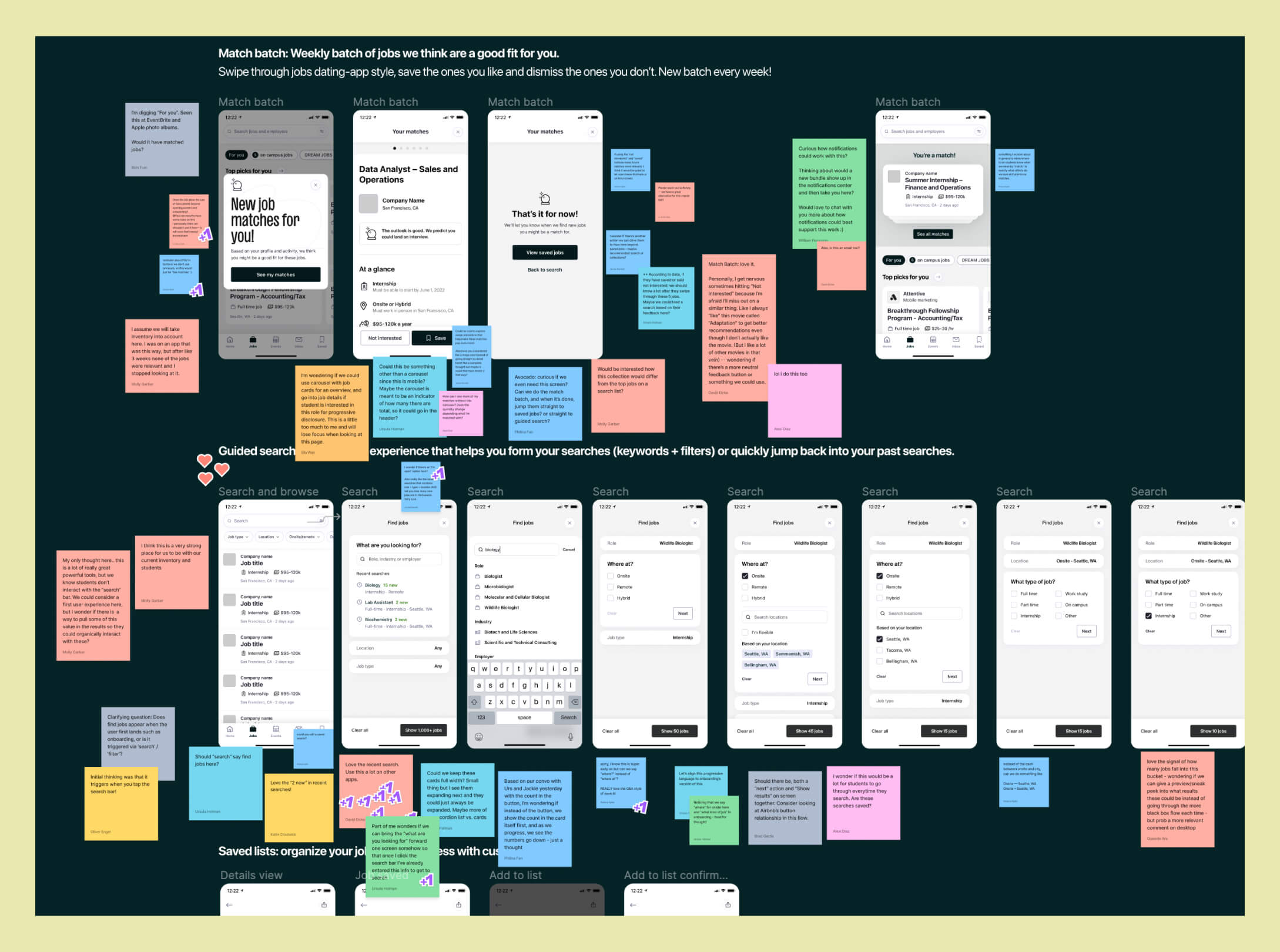
Match batch: a weekly round-up of new recommended jobs, delivered Tinder-style
This was one of the concepts I created to make Handshake's jobs platform more sticky, by re-engaging students once a week with fresh batches of recommendations.
While this experience was deprioritized in favor of other projects, it tested well with students and is one of my personal faves.
Here's what the live experience looked like when I started this work. You'll notice that it uses quite a different visual language – at the time of the project, Handshake was just beginning to transition to an updated design system.
I was one of the early adopters of the new system and took the opportunity to explore how it applied to real product scenarios.
The existing job search experience.
Process artifacts
I produced a metric ton of exploratory design work, collaborated with a user researcher to run discovery research and concept validation, and worked closely with my PM to align on the overall strategy.
I'm happy to discuss the process in more detail – here are some of the highlights.
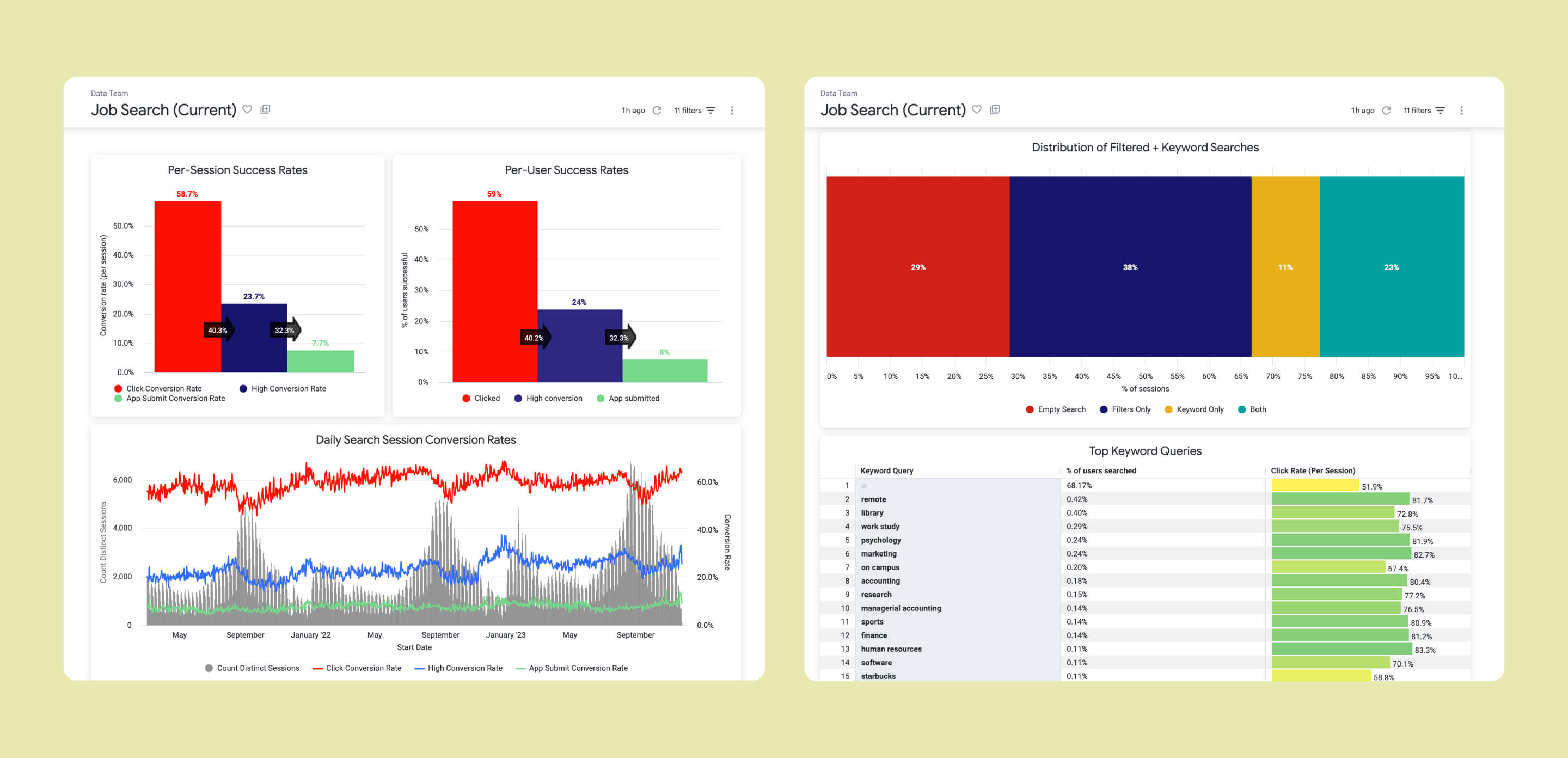
Research & data review, competitive auditing
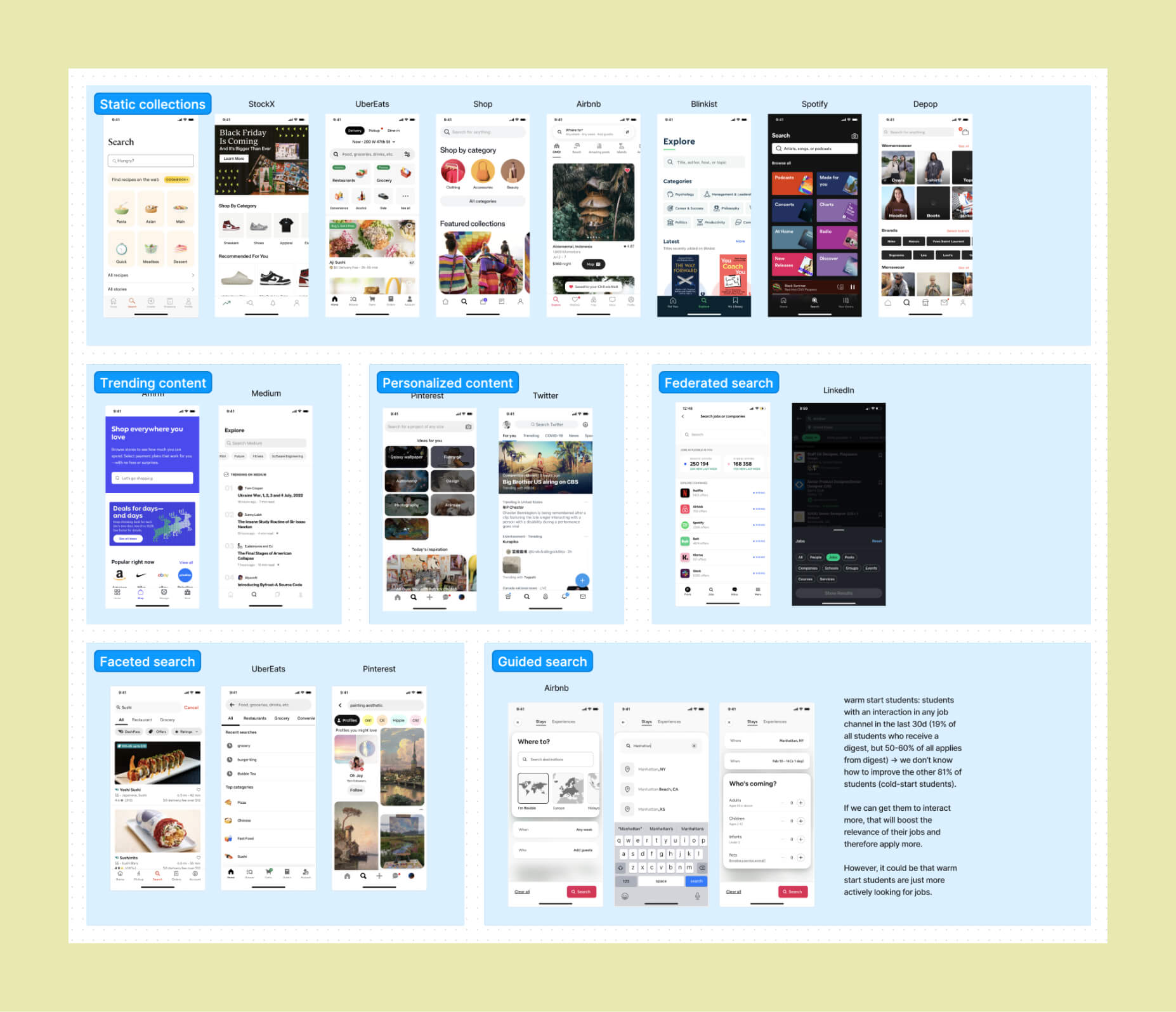
I start every project with a thorough review of available research & data and a survey of the competitive landscape.
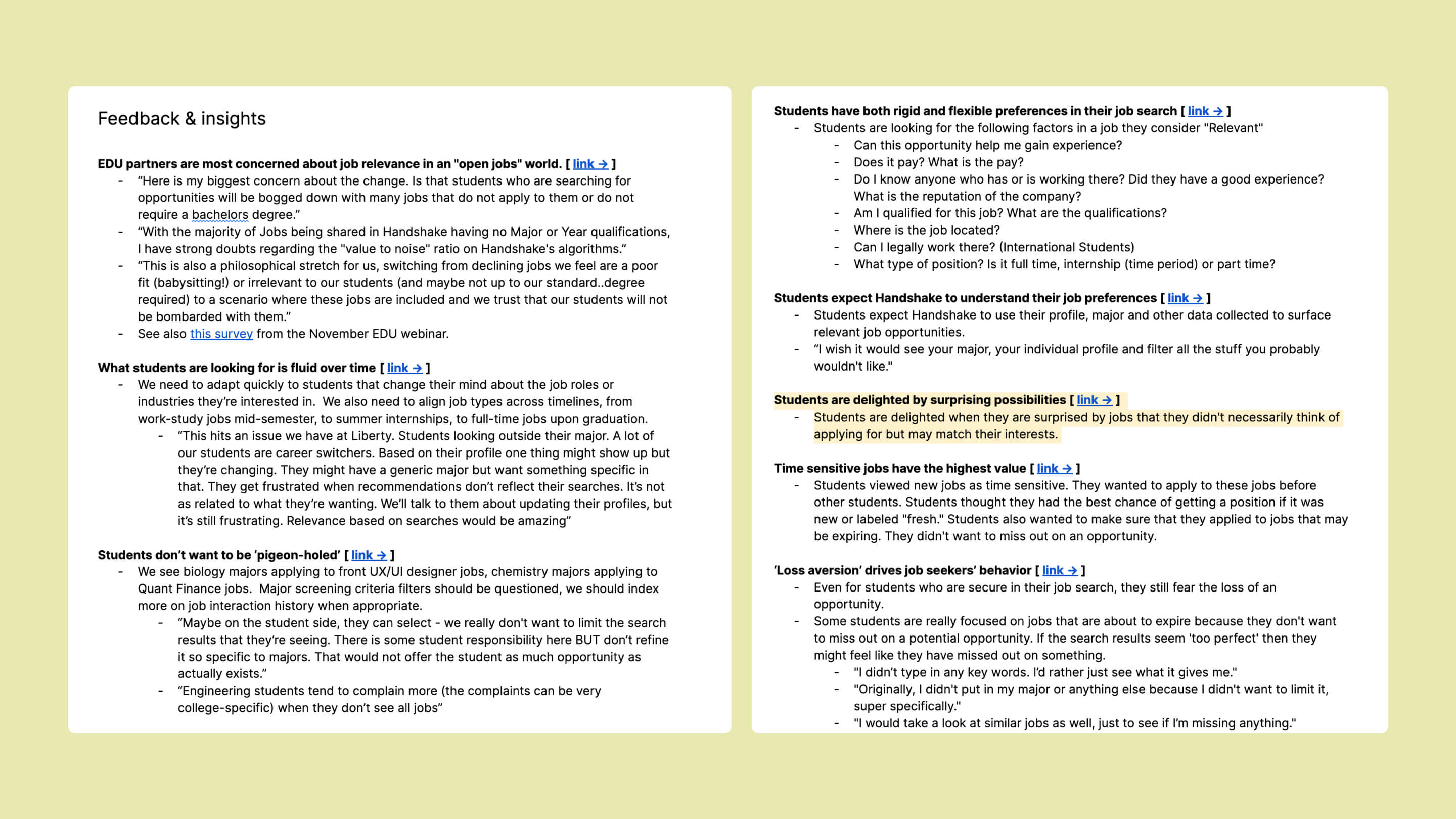
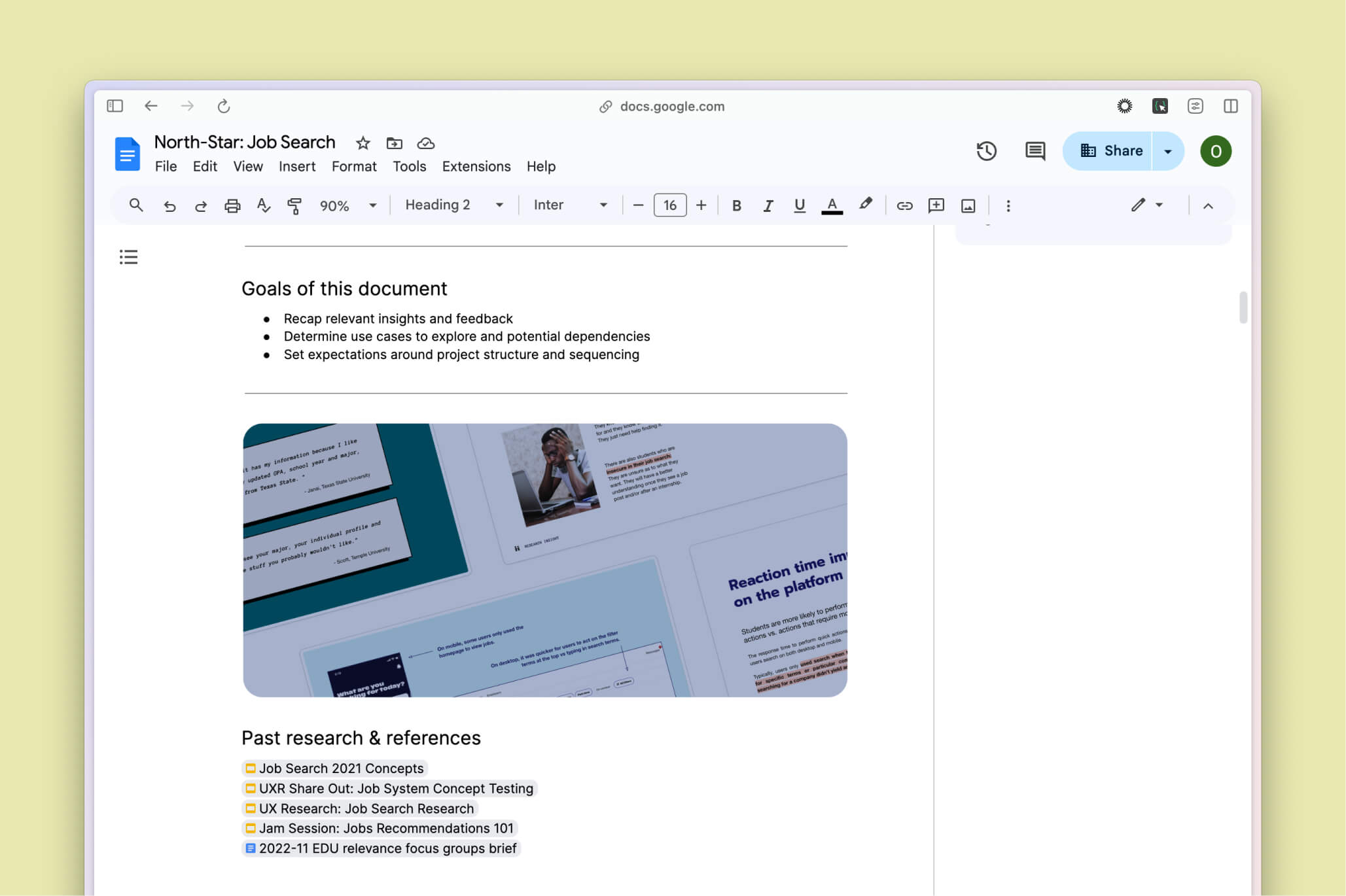
I reviewed research from last ~3 years to pull out everything relevant to job search.Working with the data team to pull relevant queries helped orient me to the state of job search.A snapshot from the competitive audit.I started a source-of-truth strategy doc to track the work and gather feedback.
Leading a cross-functional brainstorm
The project lined up nicely with a pre-planned jobs team onsite in San Francisco, about 50 members from eng, design, data, and product.
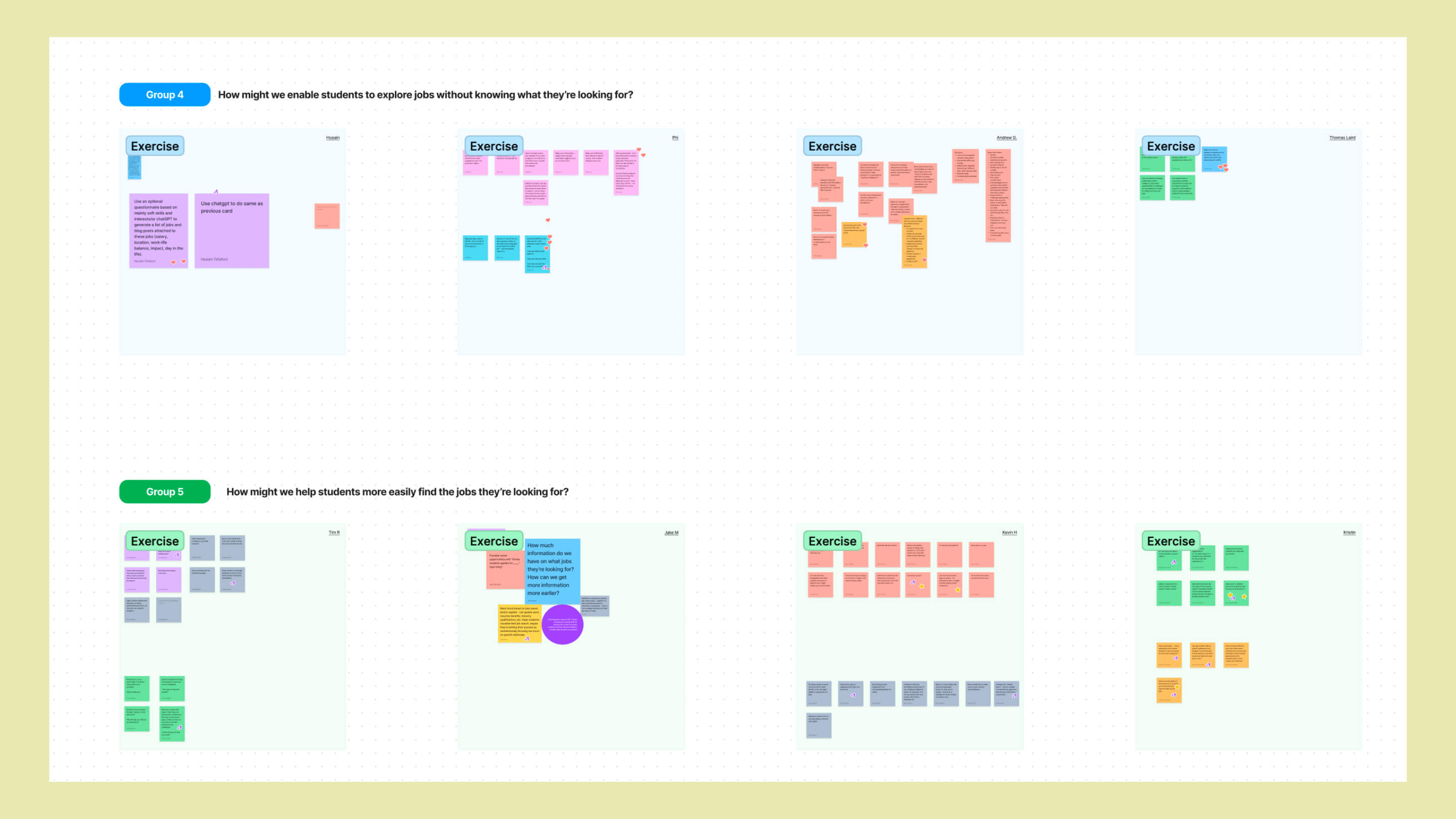
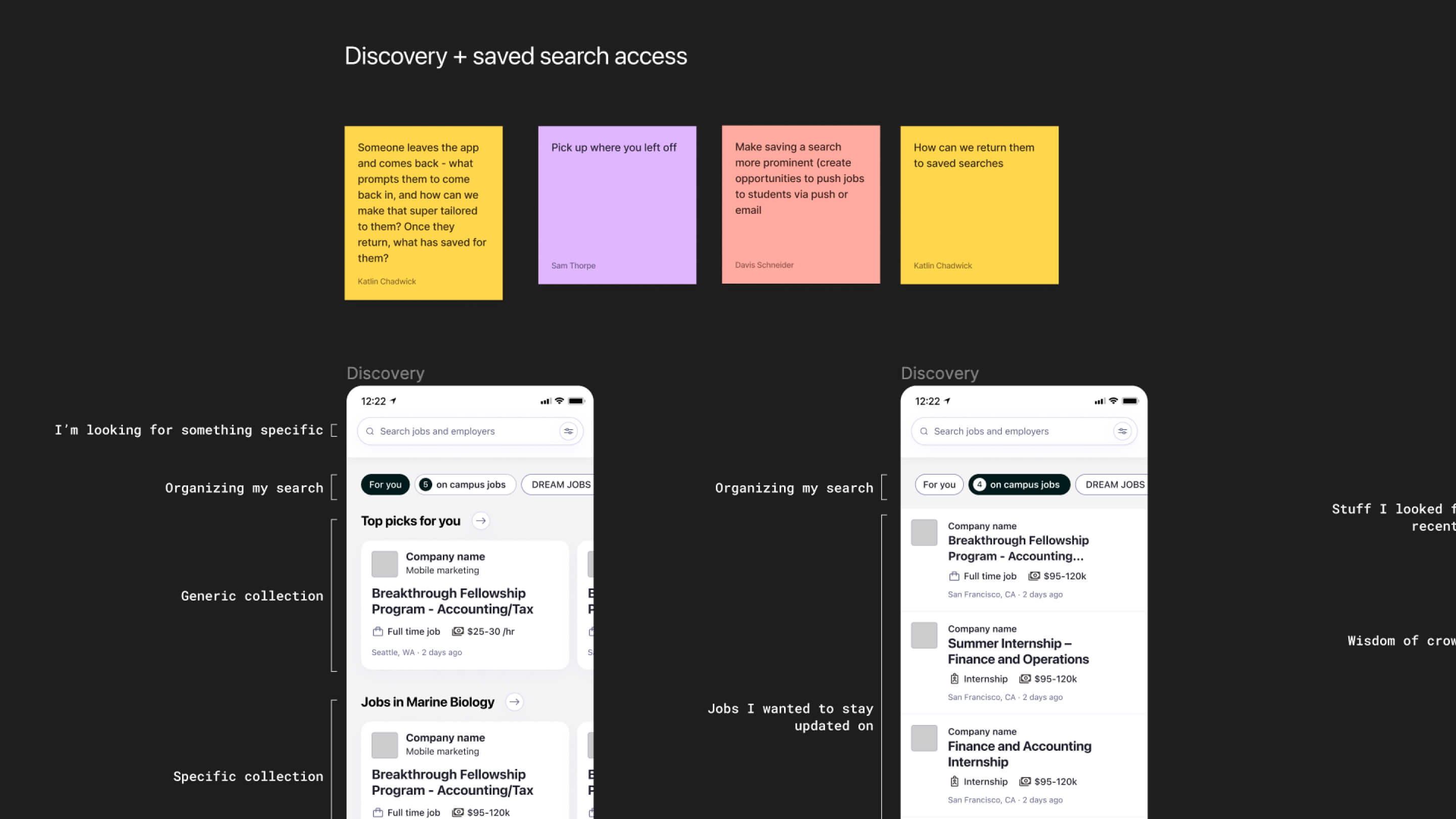
Although I couldn't attend in person, I remotely led a collaborative brainstorm that served as a 'heads up' on the project and helped generate a ton of ideas and challenges to consider.
The activities were centered around responding to a series of how might we statements that were generated in the research and auditing phase.
Snapshots from a Figjam board where I ran a series of ideation and storytelling activities.
Synthesizing & exploring
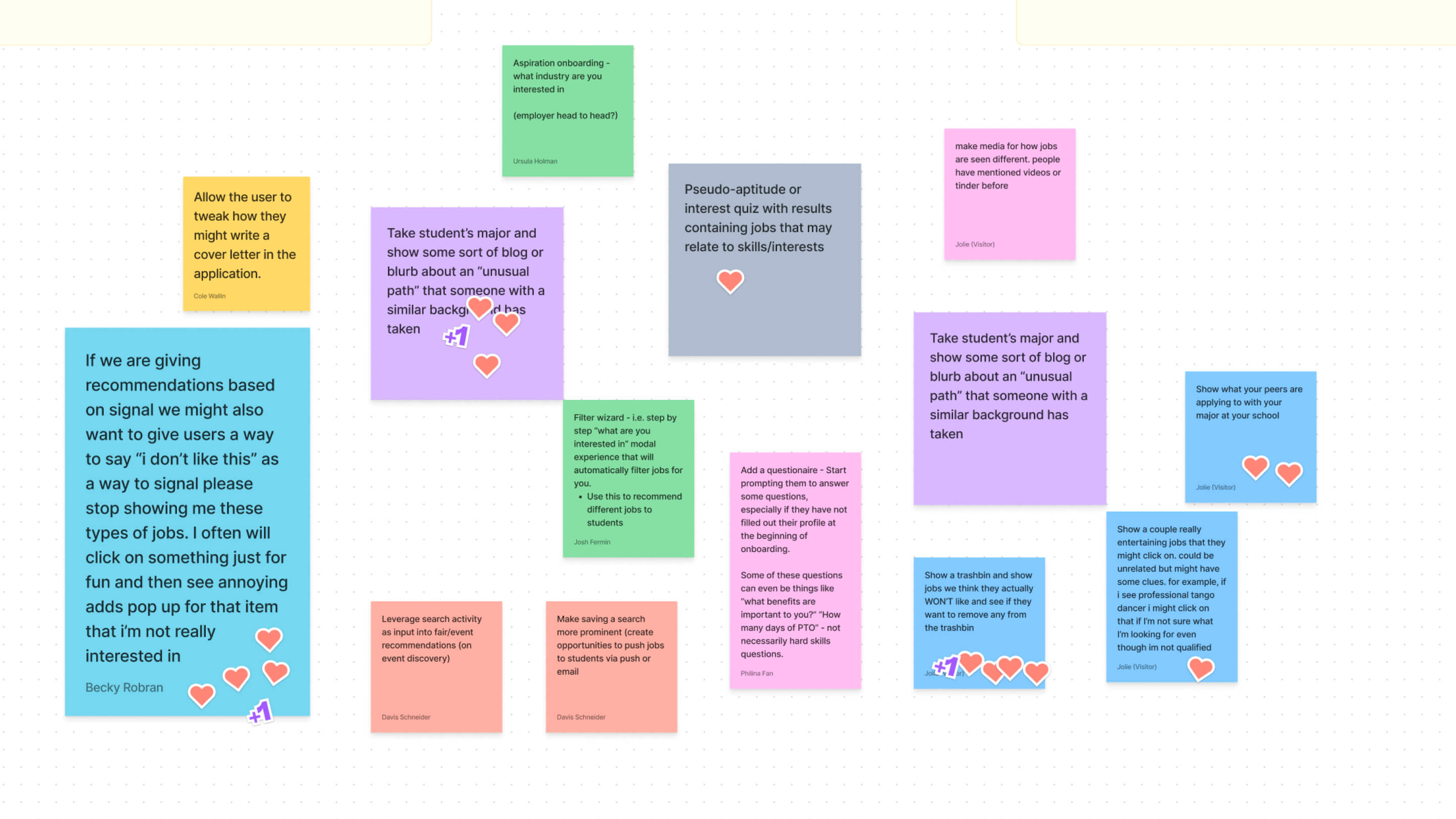
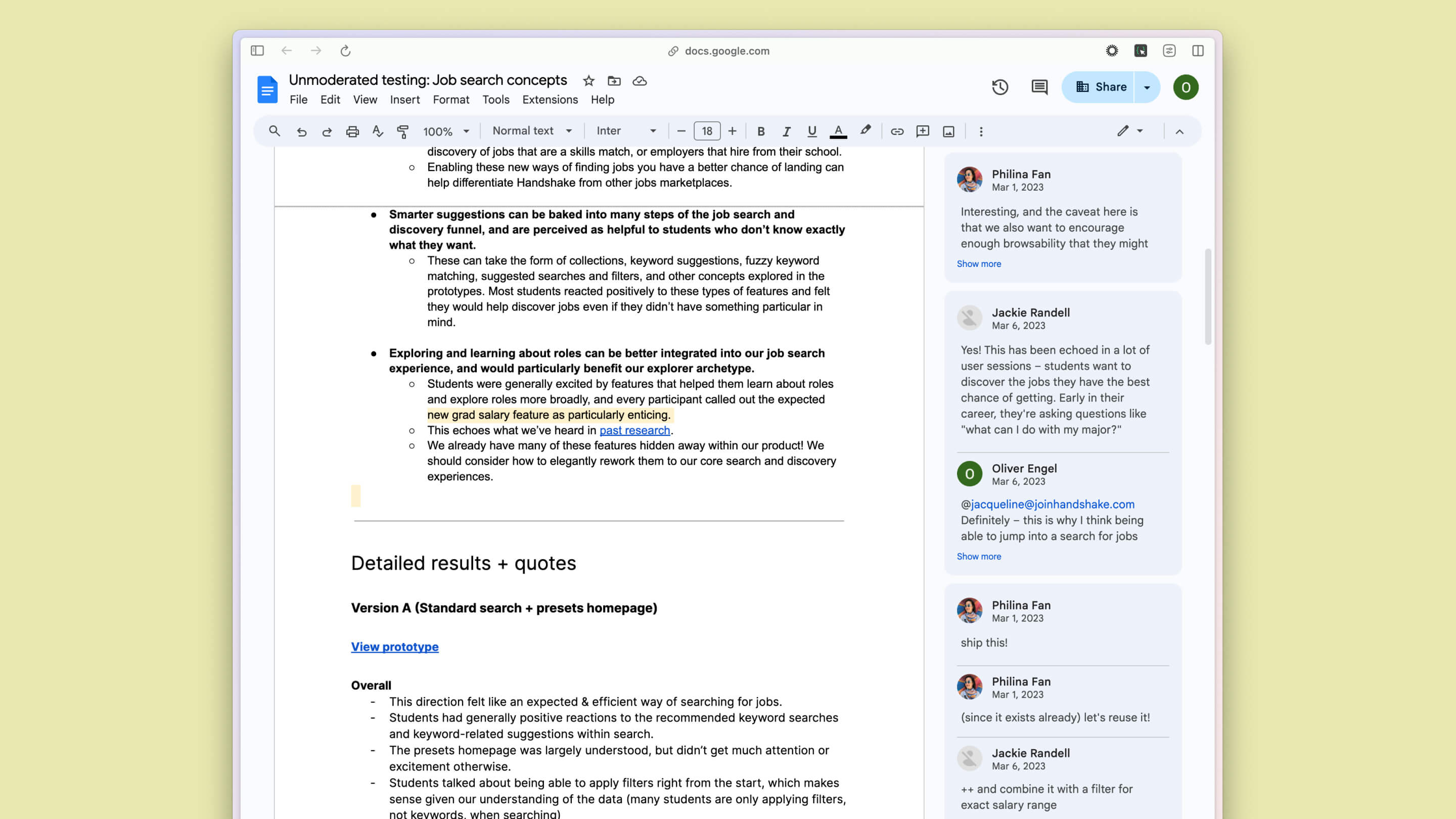
After the workshop, I synthesized out key themes and top ideas and started translating them into rough visualizations.
A series of design crits and jobs team shareouts helped refine ideas and decide which ones to pursue further.
Lots of feedback, and even more ideas.Directly translating workshop outcomes into potential directions.
Concept testing
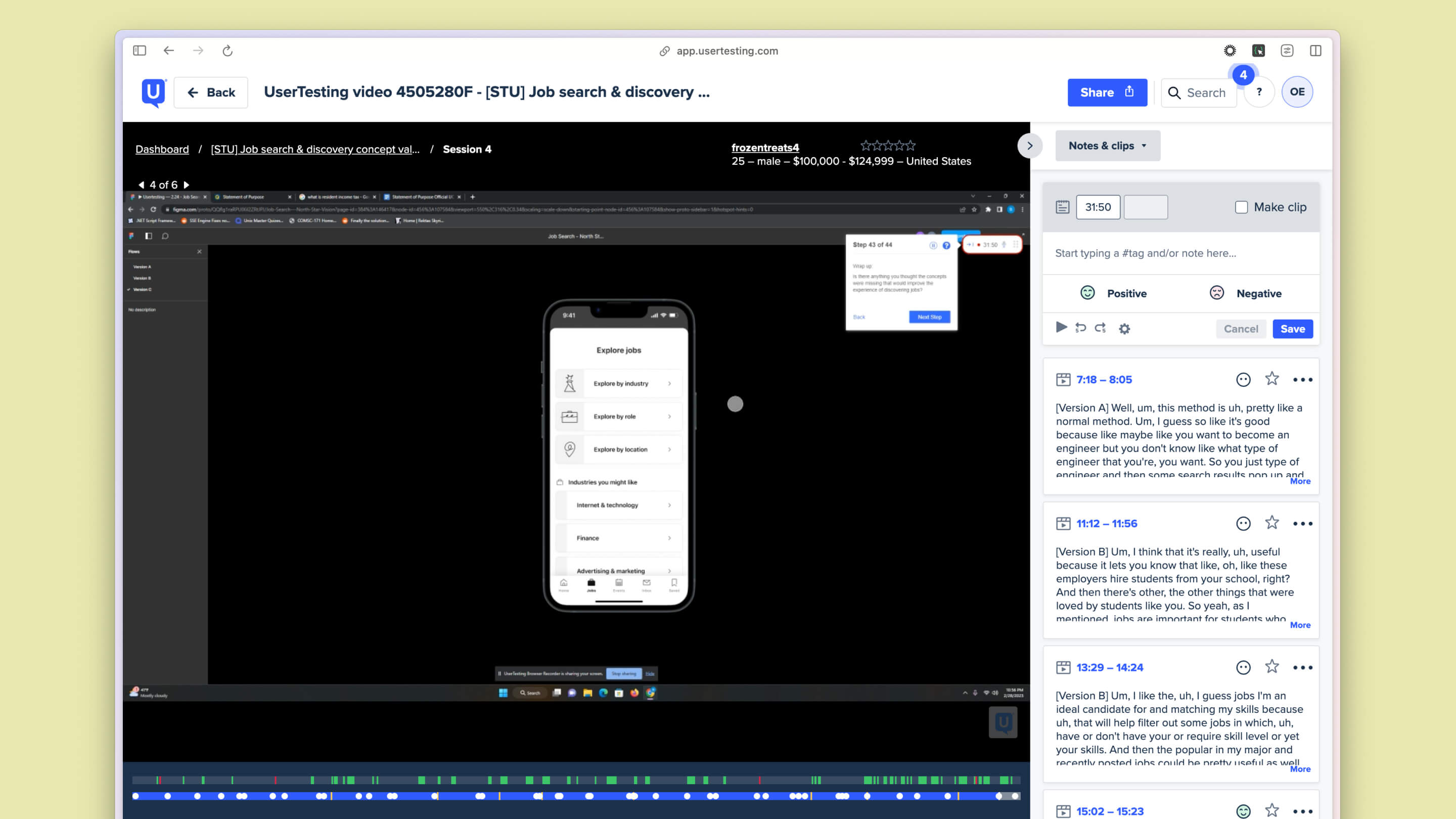
I worked with a user researcher to run a series of quick concept test + iteration cycles, tweaking the concepts each time they were shown.
Testing helped refine some ideas, archive others, and generate new ideas entirely. We used a mix of sync & async testing sessions to move quickly.
Screenshot from an unmoderated user test.Screenshot from the insights I synthesized out of testing.
Stringing the features into a cohesive experience
The suite of feature ideas needed to be demonstrated in a seamless experience in order to have any sway with leadership.
I combined a mix of near-future to further-out ideas into a single wireframed prototype and continuously workshopped it with my team. Over a series of meetings, we used the work to make the case for the overall vision and gauge leadership interest.
Below is one of the practice videos I made in this stage for feedback on the team. It's a little dry, but shows the features within a larger journey.
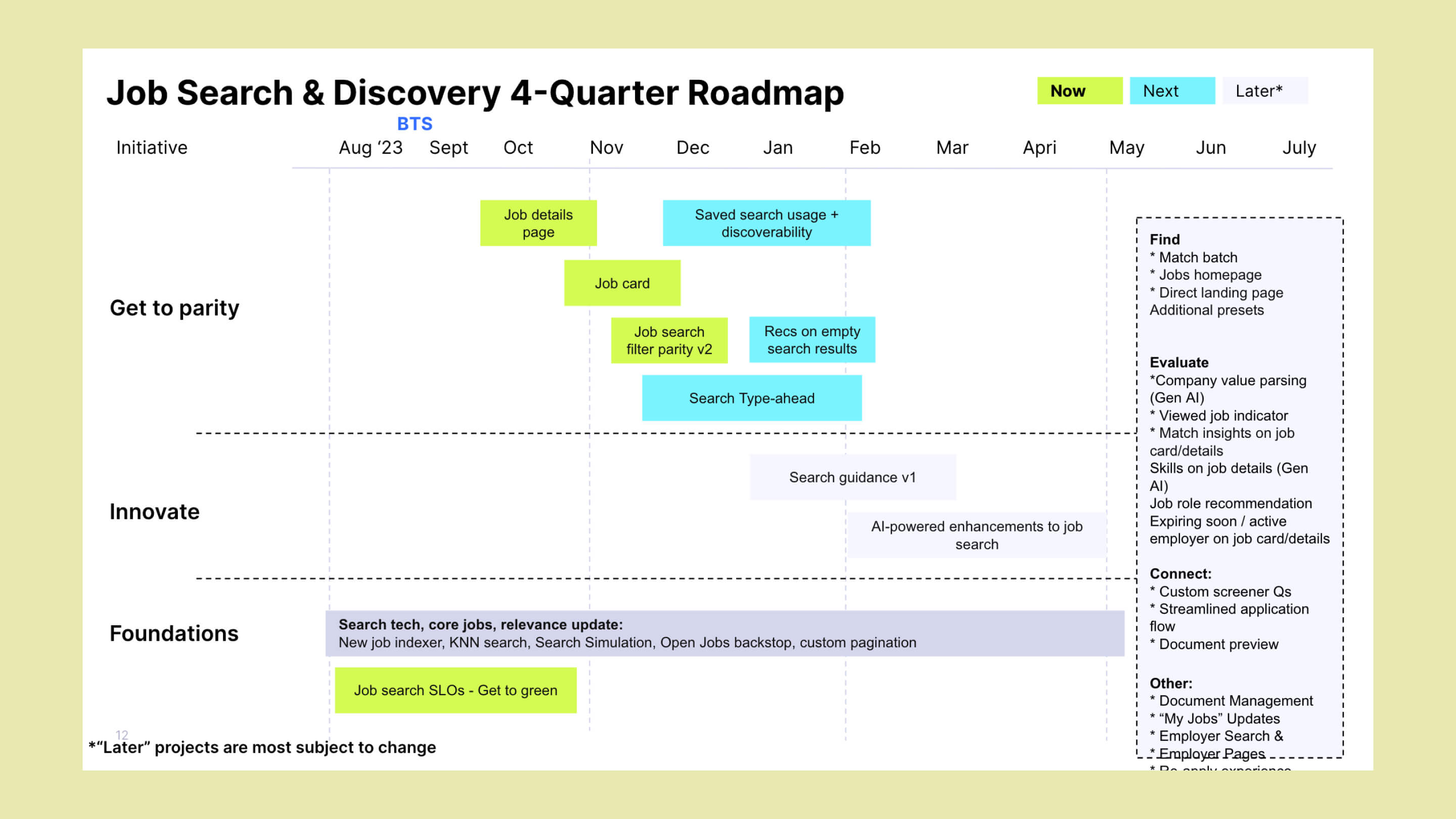
Getting on the roadmap + starting execution
A number of projects were added to the roadmap for following quarters:
Search typeahead & autosuggest (now launched)
Saved searches/job alerts (now launched)
Redesigned search filters (partially launched)
Skip to application (led by Ursula Holman)
Redesigned job details page (led by Jackie Randell)
Another set of projects were deemed “later” projects that are promising but need more investigation:
“Match batch” job matching experience
Guided job role & career path exploration
Discovery landing experience
Roadmap with the resulting projects scheduled for work.
Still here? This project was a beast, and I'm leaving plenty out. I'd be delighted to talk about it in more detail.